The financial trading world is experiencing a profound transformation, moving rapidly from traditional econometric models to sophisticated, data-driven strategies powered by Deep Learning (DL). This branch of machine learning, which utilizes multi-layered neural networks, is uniquely capable of uncovering intricate, non-linear relationships and hidden patterns within vast, noisy financial datasets.
For investors, hedge funds, and proprietary trading firms, DL algorithms represent a critical evolution, promising unprecedented advantages in risk management, predictive accuracy, and automated execution. Achieving superior returns in today’s hyper-competitive, high-frequency markets demands a robust understanding and strategic implementation of these advanced computational techniques.
This article provides an exhaustive, detailed look at the core principles, architectures, and real-world applications of deep learning that are currently optimizing and revolutionizing financial trading.
Understanding Deep Learning in Financial Context
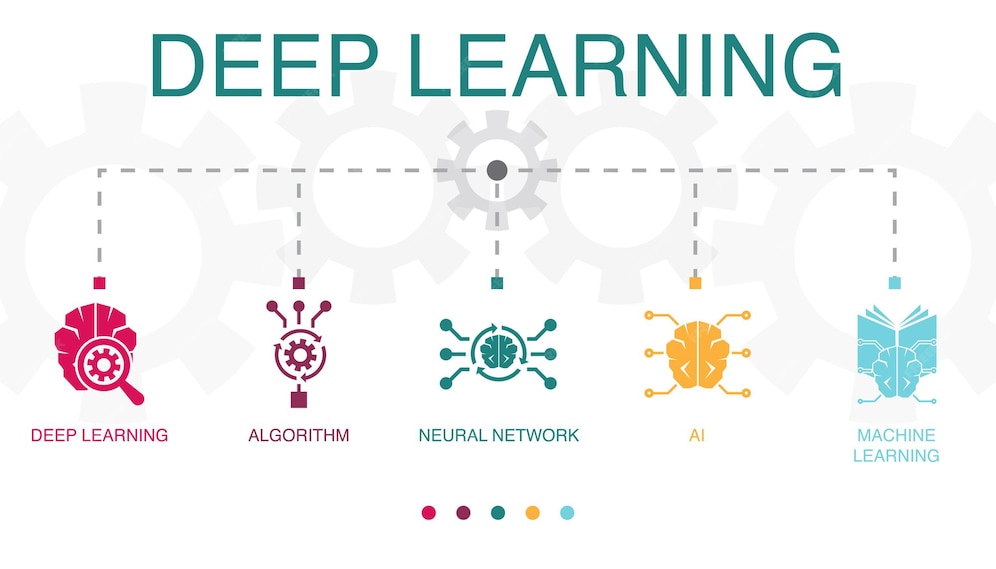
Deep learning distinguishes itself from traditional machine learning by its architecture—the use of multiple layers (deep neural networks) allows the model to progressively extract higher-level features from raw input data. This capability is paramount in finance, where market data is inherently complex and often defies simple, linear representation.
A. The Challenge of Traditional Models
Classical trading models, such as ARIMA (Autoregressive Integrated Moving Average) or GARCH (Generalized Autoregressive Conditional Heteroskedasticity), rely heavily on assumptions about data stationarity and linearity. These models struggle with:
-
A. Non-Stationarity: Financial time series data constantly changes its statistical properties over time (e.g., volatility clusters, regime shifts).
-
B. High Dimensionality: The volume and variety of data (price, volume, news sentiment, social media, economic reports) overwhelm simple models.
-
C. Non-Linear Dependencies: Price movements are influenced by complex feedback loops and psychological factors that are inherently non-linear.
Deep Learning models, with their complex architecture, can automatically learn these hierarchical features without explicit programming, making them ideal for the chaotic nature of financial markets.
B. Core Deep Learning Architectures for Trading
Several specialized neural network architectures have proven particularly effective in various trading applications:
-
A. Recurrent Neural Networks (RNNs): Specifically designed to process sequential data, making them perfect for time series analysis. They have an internal memory, allowing information from prior inputs (e.g., yesterday’s price movement) to influence the processing of the current input.
-
B. Long Short-Term Memory Networks (LSTMs): An advanced variant of RNNs, LSTMs solve the “vanishing gradient” problem, enabling them to effectively capture long-term dependencies in the data. This is crucial for identifying trends or cycles that span months or even years.
-
C. Convolutional Neural Networks (CNNs): Primarily known for image processing, CNNs are adapted in finance to treat time series data as a one-dimensional “image.” They excel at identifying localized patterns (short-term fluctuations or specific candlestick formations) across multiple assets simultaneously.
-
D. Autoencoders (AEs): Used for unsupervised learning, AEs are excellent for dimensionality reduction and noise filtering. They compress high-dimensional trading data into a lower-dimensional latent representation, effectively extracting the most crucial information while discarding irrelevant noise, which is vital for building robust features.
Applications of Deep Learning in Trading Strategies
Deep learning algorithms are deployed across the entire spectrum of trading operations, from fundamental analysis to high-frequency execution.
1. Enhanced Market Prediction and Forecasting
The most direct application is forecasting future price movements, a notoriously difficult task. Deep learning moves beyond predicting absolute prices to predicting directional movements or volatility.
-
A. Directional Prediction: LSTMs are fed multivariate time series data (e.g., closing price, volume, moving averages, inter-market data) to predict the probability of an asset moving up or down in the next trading period. Their sequential memory helps capture subtle momentum shifts missed by traditional technical indicators.
-
B. Volatility Forecasting: Accurate volatility prediction is essential for options trading and risk management. DL models, particularly those using attention mechanisms, can model the complex relationships between fundamental announcements, geopolitical events, and subsequent market volatility more accurately than classical GARCH models.
-
C. Regime Change Detection: Using unsupervised learning techniques like clustering within a DL framework, algorithms can identify shifts in market dynamics—for instance, moving from a low-volatility, trending regime to a high-volatility, mean-reverting regime. Trading strategies are then dynamically adjusted based on the predicted regime.
2. Algorithmic Trading and Execution
Deep learning enables the creation of sophisticated, autonomous trading agents that learn optimal trading actions directly from market data.
-
A. Reinforcement Learning (RL) for Execution: RL, a powerful area often implemented with deep neural networks (Deep Reinforcement Learning – DRL), trains an agent (the algorithm) to make a sequence of decisions (buy, sell, hold) in a simulated market environment. The agent learns an optimal policy by maximizing a cumulative reward (e.g., profit) over time. Unlike supervised learning, DRL doesn’t require labeled historical data; it learns through trial and error, making it highly adaptive to changing market conditions.
-
B. Optimal Trade Sizing: DRL agents can be trained to determine the optimal size of a trade given current portfolio risk, market liquidity, and predicted price impact. This is crucial for large institutional orders where poor execution can significantly erode alpha.
-
C. Market Microstructure Modeling: High-frequency trading (HFT) relies on understanding the microscopic dynamics of order books. DL models can analyze millions of order book updates per second to predict short-term imbalances and optimal placement times, generating superior execution performance compared to simpler latency-arbitrage models.
3. Sentiment Analysis and Alternative Data Integration
Deep learning excels at processing unstructured and alternative data, turning qualitative information into quantitative trading signals.
-
A. Natural Language Processing (NLP) for News: DL-based NLP models can parse thousands of news articles, earnings reports, regulatory filings, and social media posts in real-time. Crucially, they go beyond simple word counting to understand the context, tone, and semantic meaning of financial statements, extracting actionable sentiment scores that predict short-term price reactions.
-
B. Social Media and Forum Analysis: LSTMs and transformers (like BERT) are used to analyze trader chatter on platforms like X (formerly Twitter) or Reddit’s WallStreetBets. The model must learn to differentiate between genuine market conviction, coordinated pump-and-dump schemes, and irrelevant noise, a complex task that only deep learning can handle effectively.
-
C. Satellite Imagery and Geospatial Data: CNNs are employed to analyze satellite images (e.g., counting cars in retail parking lots or monitoring commodity production sites) to derive proprietary, non-public economic indicators that can be used to predict corporate earnings before they are officially released.
Implementing and Training Deep Learning Models
Successfully deploying deep learning for trading is a complex process involving specialized data preparation and rigorous validation.
1. Data Preprocessing and Feature Engineering
The quality of the input features is the single most important factor for deep learning performance.
-
A. Feature Construction: Inputs often include engineered features like technical indicators (RSI, MACD), statistical measures (rolling volatility, skewness), and market microstructure features (bid-ask spread, order book depth). DL models are powerful, but providing them with well-constructed features significantly accelerates learning.
-
B. Normalization and Scaling: To prevent initial layers from being dominated by features with larger numerical ranges (e.g., price vs. volume), all inputs must be rigorously normalized (e.g., Z-score scaling) or scaled to a fixed range (e.g., [0, 1]) before feeding them into the neural network.
-
C. Dealing with Missing Data: Financial data is often incomplete due to trading halts or data feed errors. DL requires complete inputs, necessitating robust imputation techniques (e.g., using interpolation or, in advanced cases, using Generative Adversarial Networks (GANs) to predict the missing values).
2. Model Training and Validation
Training DL models requires specialized techniques to handle the unique challenges of financial time series data.
-
A. Walk-Forward Validation: Traditional cross-validation (randomly splitting the dataset) is invalid for time series because it introduces look-ahead bias (using future data to train past predictions). Walk-forward validation is mandatory: the model is trained on a defined historical window, tested on the next future window, the window slides forward, and the process repeats. This mimics real-world trading.
-
B. Overfitting Mitigation: Deep learning models, with millions of parameters, are highly susceptible to overfitting (learning the noise of the training data rather than the underlying pattern). Techniques like Dropout (randomly ignoring neurons during training) and L1/L2 Regularization are essential to maintain generalization capability.
-
C. Hyperparameter Optimization: Optimal performance depends heavily on hyperparameters (e.g., learning rate, number of layers, number of neurons per layer). Techniques like Bayesian Optimization or Evolutionary Algorithms are often used to automate the exhaustive search for the optimal configuration, a process that is extremely computationally intensive.
Risks and Limitations of Deep Learning in Trading
Despite the immense potential, deep learning introduces significant risks that must be meticulously managed.
1. Black Box Risk and Interpretability
Deep neural networks are often referred to as “black boxes” because it is difficult to trace why a specific prediction or trading decision was made.
-
A. Lack of Explainability: Unlike linear models, it is challenging to explain the weight and influence of individual input features on the output. This lack of transparency is a major compliance and risk hurdle for financial institutions, which require justification for all major trading decisions.
-
B. Adversarial Attacks: Researchers have shown that tiny, carefully crafted perturbations to the input data (invisible to humans) can cause a DL model to misclassify dramatically (e.g., predicting a strong buy instead of a strong sell). This vulnerability to targeted market manipulation is a serious emerging concern.
-
C. Regulatory Compliance: Regulators are increasingly scrutinizing algorithmic trading systems. The lack of interpretability in deep learning complicates the demonstration that a firm’s trading algorithms are not engaged in illegal activities like spoofing or market manipulation.
2. Data and Computational Requirements
Deep learning is resource-intensive, creating high barriers to entry for smaller firms.
-
A. Data Hunger: DL models, particularly complex DRL agents, require vast quantities of high-quality, minute-by-minute or tick-level data, which is expensive to acquire, store, and preprocess.
-
B. Computational Expense: Training deep neural networks demands massive computational resources, often requiring specialized GPU (Graphics Processing Unit) or TPU (Tensor Processing Unit) clusters to handle the matrix multiplications efficiently. The iterative nature of DRL, which requires running thousands of simulations, exacerbates this cost.
Future Trajectory: Towards Autonomous and Adaptive Systems
The next phase of deep learning in trading will focus on increased autonomy, integration, and the generation of synthetic data.
A. Modular and Ensemble Systems
Future systems will move away from single, monolithic models toward ensemble methods where multiple specialized DL models are combined.
-
A. Hybrid Models: Combining the strengths of different architectures, such as using a CNN to extract features from time series data and feeding those features into an LSTM for sequential prediction, will become standard.
-
B. Hierarchical DRL: A high-level DRL agent may decide on the overall portfolio allocation (e.g., overweighting tech stocks), while low-level agents manage the execution strategy for individual assets, creating a robust, multi-layered decision hierarchy.
B. Generative Adversarial Networks (GANs)
GANs will be increasingly used to generate realistic synthetic financial data.
-
A. Synthetic Data Augmentation: By training a GAN to mimic the statistical properties and non-linear dependencies of real market data, firms can generate unlimited synthetic data to train and test their DRL agents, mitigating the problem of limited historical data and reducing the risk of overfitting to a single historical path.
-
B. Scenario Analysis: GANs can be used to generate simulated “black swan” or extreme market stress scenarios that have never occurred historically, allowing risk managers to robustly stress-test their models and strategies.
C. Edge Computing and Low-Latency Deployment
For high-frequency applications, the neural network inference (making a prediction) must occur in microseconds. Future developments will focus on model compression and deploying inference engines closer to the exchange servers (edge computing) to minimize latency, ensuring the DL-powered trades are executed before the market moves.
Conclusion
Deep learning algorithms are not merely optimizing trading; they are fundamentally redefining the capabilities of market participants. Their ability to process massive amounts of complex, unstructured data and autonomously learn optimal strategies gives firms a persistent competitive edge. As computational costs decrease and data access improves, deep learning will become the essential toolkit for success in modern quantitative finance, setting the new benchmark for alpha generation and intelligent risk management.